Tuesday, 15 October 2013


2013 Bar Exam Takers I Personally Knew


32. ABDUL W AHID, Shahana E.
Classmate in English 30 and former USC chairperson

281. AMBRONA, Venus B
        2009 Polsci batchmate

557. BADI, Carla Mae E.
UP KAPPP orgmate

810. BELTRAN, Richard Henrick I.
        2009 Polsci batchmate

1339. CEREZO, Arianne Y.
        2009 Polsci batchmate and our college valedictorian

1416. COLOBONG, Moises Ronette C.
          Fil 40 classmate

1755. DELA CRUZ, Alexis Ian P. 
          2009 Polsci batchmate

2443. GERONIMO, Benjamin Joseph Y
          2009 Polsci batchmate

2787. JULKIPLI, Mohammad Al-amin M.
          2009 Polsci batchmate

3118. LOPEZ, Gene Edward DC
         Philo major who was a classmate in a Political Science class

3303. MALABANAN, Marie Krizel P.
          2009 Polsci batchmate

3444. MARI, Marjorie H. 
          2009 Polsci batchmate

3816. NUÑEZ, Samantha Louise J
          Upperclass student in UP Law

4229. POMOY, Rashel Ann C.
          Philo major and classmate in Philo 114 (Phenomenology and Existentialism)

4269. PULIDO, Paula Editha I.
          UP Ex Libris orgmate

4853. SERRANO, Janz Hanna Ria N.
         2009 Polsci batchmate
5467. VILLANUEVA, Viviene B. 

Saturday, 21 September 2013


From http://www.gov.ph/featured/declaration-of-martial-law/

This is actually an article on the Official Gazette (Philippine Goverment's official publication). It argued that September 23 is the real start of Martial Law no September 21.

Declaration of Martial Law

The anniversary of the declaration of martial law is on September 23 (not September 21) 
President Jose P. Laurel issued Proclamation No. 29 on September 21, 1944 placing the Philippines under martial law, effective September 22, 1944. Marcos followed a similar process, although he did not actually sign his Proclamation No. 1081 on September 21: he signed it on September 17 or on September 22, in either case dating it September 21.
Throughout the martial law period, President Marcos built up the cult of September 21, proclaiming it National Thanksgiving Day by virtue of Proclamation No. 1180 s. 1973 to memorialize the date as the foundation day of his New Society. The propaganda effort was so successful that up to the present, many Filipinos, particularly those who did not live through the events of September 23, 1972, labor under the misapprehension that martial law was proclaimed on September 21, 1972. It was not.
The facts are clear. A week before the actual declaration of Martial Law, a number of people had already received information that Marcos had drawn up a plan to completely take over the government and gain absolute rule. Senator Benigno S. Aquino, Jr., during a September 13, 1972 privilege speech, thus exposed what was known as “Operation Sagittarius”. The Senator said he had received a top-secret military plan given by Marcos himself to place Metro Manila and outlying areas under the control of the Philippine Constabulary as a prelude to Martial Law. Marcos was going to use the bombings, which includes the Plaza Miranda Bombing, in Metro Manila as a justification for his takeover and subsequent authoritarian rule. In his own diary, President Marcos in his entry for September 14, 1972, wrote that he informed the military that he would proceed with proclaiming martial law.
 This was indeed the culmination of a long period of preparation: in his January 1971 diary entries, Marcos discussed meeting business leaders, intellectuals from the University of the Philippines, and the military, to lay the groundwork that extreme measures would be needed in the future. By May 8, 1972, in his diary, Marcos confided that he had instructed the military to update its plans, including the list of personalities to be arrested, and had met with Secretary Juan Ponce Enrile to finalize the legal paperwork required.
Senator Benigno S. Aquino, Jr. delivers a privilege speech on the Senate floor on September 21, two days before martial law was declared and implemented. (From A Garrison State in the Make, p. 353)
On September 21, 1972, democracy was still functioning in the Philippines. On same date, Senator Benigno S. Aquino, Jr. delivered his final privilege speech in the senate.
Thursday, September 21, 1972 was the last session day of the week. Primitivo Mijares, among others, recounted the functioning of the House of Representatives and the Senate, with committee meetings scheduled for that night.
That afternoon, as Edicio de la Torre[1] recounted in 2009, a protest march was held in Plaza Miranda, sponsored by the Concerned Christians for Civil Liberties (Eva-Lotta E. Hedman, John Thayer Sidel in their book Philippine politics and society in the twentieth century: colonial legacies, post-colonial trajectories, says this rally was led by a coalition of “more than thirty civic, religious, labor, student and activist groups [and] mobilized a crowd of 30,000 in a protest rally at Plaza Miranda which received prominent national radio, television, and newspaper coverage.”). For his part, in his diary, President Marcos wrote that he, together with members of his cabinet and staff, finished the preparation of Proclamation 1081 at 8 PM, September 21.
A day after the final speech of Ninoy Aquino, that is, September 22, 1972, the newspapers still came out: they featured the rally held the previous day in Plaza Miranda. Mijares in his book recounts President Marcos was agitated by a statement reported in the Daily Express that if martial law were declared, Aquino said he would have to be arrested soon after or he would escape to join the resistance to martial rule.
The pretext for martial law was provided later in the evening of Friday, September 22, 1972[2], the convoy of Secretary of Defense Juan Ponce Enrile was ambushed in Wack-Wack as he was going home to Dasmariñas village in Makati before 9 PM. This ambush, as Enrile later revealed in 1986, was staged by Marcos to justify Martial Law. Marcos himself, in his diary entry for September 22, 1972 (9:55 PM) wrote, “Sec. Juan Ponce Enrile was ambushed near Wack-Wack at about 8:00 pm tonight. It was a good thing he was riding in his security car as a protective measure… This makes the martial law proclamation a necessity.” His diary entry for September 25, 1972 mentions conditions after two days of martial law, also indicating martial law in reality is dated to September 23, 1972.
This means that when President Ferdinand E. Marcos appeared on television at 7:15 PM on September 23, 1972, to announce that he had placed the “ entire Philippines under Martial Law” by virtue of Proclamation No. 1081, he framed his announcement in legalistic terms that, however, were untrue, and that has helped camouflage the true nature of his act, to this day: for it was nothing less than an autogolpe, or self-coup. He said he had placed the entire country under martial law as of 9 PM on September 22, 1972, which, he claimed, he signed on September 21, 1972.
Yet accounts differ. David Rosenberg, writing in the Bulletin of Concerned Asian Scholars (“The End of the Freest Press in the World,” Vol. 5, 1973) chronicled that about six hours after the ambush, President Marcos signed Proclamation No. 1081, placing the entire country under Martial Law, placing the signing at around 3 AM on September 23. Raymond Bonner, in his book Waltzing with the Dictator, narrates his interview with Juan Ponce Enrile with which the former Defense Secretary recalls that he and Acting Executive Secretary Roberto Reyes witnessed President Marcos sign Proclamation No. 1081 in the morning of September 23, 1972. The Bangkok Post in a series of articles called “The Aquino Papers” published in February 20 – 22 of 1973, asserted Proclamation No. 1081 had been signed even earlier, on September 17, 1972, postdated to September 21. Mijares also mentioned in his book that President Marcos said as much in an address to a conference of historians, in January, 1973.
Two things emerge: first, whether they conflict or not, accounts all indicate President Marcos’ obsession with numerology, seven being his lucky number, necessitated that Proclamation No. 1081 be officially signed on a date that was divisible by seven. Thus, September 21, 1972 became the official date that Martial Law was established and the Marcos dictatorship began. It also allowed Marcos to control history on his own terms.
The second is that the arbitrary date underscores that the actual date for martial law was not the numerologically-auspicious (for Marcos) 21st, but rather, the moment that Martial Law was put into full effect, which was after the nationwide address of Ferdinand Marcos as far as the nation was concerned: September 23, 1972. By then, personalities considered threats to Marcos (Senators Benigno S. Aquino Jr., Jose Diokno, Francisco Rodrigo and Ramon Mitra Jr., and members of the media such as Joaquin Roces, Teodoro Locsin Sr., Maximo Soliven and Amando Doronila) had already been rounded up, starting with the arrest of Senator Aquino at midnight on September 22, and going into the early morning hours of September 23[3], when 100 of the 400 personalities targeted for arrest were already detained in Camp Crame by 4AM.
In the meantime, the military had shut down mass media, flights were canceled, incoming overseas calls were prohibited. Press Secretary Francisco Tatad went on air at 3PM on September 23 to read the text of Proclamation No. 1081. The reading of the proclamation was followed by President Marcos going on air at 7:15 p.m. to justify the massive clampdown of democratic institutions in the country. He would subsequently issue General Order No. 1, asserting that all powers had been transferred to the President who was to rule by decree. Congress would not convene until, in anticipation of it in January, 1973, President Marcos accelerated the “approval” of a new constitution to preempt the legislature.
The New York Times reported about these events in an article entitled Mass Arrests and Curfew Announced in Philippines; Mass Arrests Ordered in Philippines in their September 24, 1972 issue. The Daily Express itself, announced in its September 24 issue, that President Marcos had proclaimed martial law the day before, September 23, 1972.
After the declaration and imposition of Martial Law, citizens would still go on to challenge the constitutionality of Proclamation No. 1081. Persons arrested filed petitions for habeas corpus with the Supreme Court. But President Marcos, who had originally announced that martial law would not supersede the 1935 Constitution, engineered the replacement of the constitution with a new one. On March 31, 1973, the Supreme Court issued its final decision in Javellana v. Executive Secretary, which essentially validated the 1973 Constitution. This would be the final legitimizing decision with on the constitutionality of Martial Law: in G.R. No. L-35546 September 17, 1974, the Supreme Court dismissed petitions for habeas corpus by ruling that martial law was a political question beyond the jurisdiction of the court; and that furthermore, the court had already deemed the 1973 Constitution in full force and effect, replacing the 1935 Constitution.
Martial Law would officially end on January 17, 1981 with Proclamation No. 2045. President Marcos, however, reserved decree-making powers for himself.
Today, the Constitution safeguards our institutions from a repeat of martial law. The Supreme Court is empowered to review all official acts to determine if there has been grave abuse of discretion. Congress cannot be padlocked. Martial Law is limited in duration and effects, even if contemplated by a president.


P.S.  I just hope that the Philippines move on. No we must not forget but we must forgive. For me that is the true essence of moving one

Friday, 20 September 2013


The Saysay (Worth) of Monching Magsaysay


            “Too much people’s money spent but there is no honest government”.  This statement might reflect the current state of the Philippines which is now being embroiled with the Napoles pork barrel scam. Actually, it is a line from a famous political jingle, the Mambo Magsaysay, used by President Ramon “Monching” Magsaysay when he ran for president in 1953. It seems our country had not changed since the past sixty years. We will never have a president like Ramon del Fierro Magsaysay. We could have a future Manuel Quezon, Gloria Arroyo or even a Gloria Arroyo but never a Monching, a president who is a true man of the masses or in his words of the common tao.

            Actually, my fascination with Monching manifested only when I was in college. History lessons in elementary and high school mentioned him but simply as the “man of the masses without any further elaboration. My teachers then would say that President Marcos was the greatest president the Philippines had ever had. This is understandable since I was a native of Ilocos Norte, the home province of Marcos, and that my parents and teachers met him when he was alive. However, that changed during my first year in college when I took up Kasaysayan (History) class and our professor required us to submit an article or term paper regarding periods of Philippine history. Luckily for me, I was given to write about the life of President Magsaysay. I lost my article when my old computer broke down but I still remember the books, old newspaper articles, and online article that I scoured in the different libraries in UP Diliman about him. His character, works, achievements, and anecdotes about him made a big impression on me. To this day, I still remember what he had done. I also asked my parents and older people who were alive when he was a president and all of them gave a good impression on him. It confirmed my impression on him that he is a president sui generis or a class of his own.
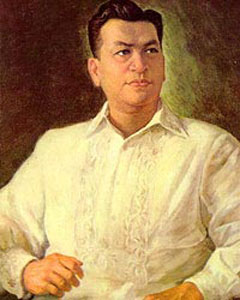
            To put it simply, Monching made the Philippine presidency worthwhile (may saysay). When he was elected as president in 1953, he broke a lot of the tradition or stereotype of a Philippine president. First, his name was first one that was not of Spanish or Chinese origin (e.g. Quezon, Aguinaldo etc). What could have been a fitting name for the first populist president but one derived from the masses? Second, he was the first to be born during the 1900s and the first one not to be associated with the old guards of Philippine politics. He was a breath of fresh air from the usual stiff, elitist politicians. Third, he was the first to wear a barong in his presidential portrait unlike his predecessor who wore coat and tie (very uncomfortable in our tropical weather).That image alone was a big testament on how different he was. The barong was the dress of the masses during their weddings, funerals or any occasions. Fourth, he was the first president who did not take up in law or liberal arts either in UP or UST. He was a mechanical engineering from the Jose Rizal University and worked as a mechanic in a bus company unlike the previous presidents who worked as lawyers, soldiers or full-time politicians.
            During the Second World War, he joined Filipino guerillas in their fight against the Japanese invaders and subsequently given some medals and awards. After the war, he returned to his former occupation but it will not to be long before the country will need his service. The war had ravaged the Philippines and created societal and political disorder. The Huks, who used to fight the Japanese, had now turned against the newly established Philippine Republic. It was weak then as it is recovering from the war. In fact, the Philippine military was so weak and demoralized that the Huks easily captured some Philippine provinces. The Huks were so strong that even their leader Luis Taruc could even go to Manila without fear of being captured. The Huks were nearing the outskirts of Manila, ready to make the country a Communist state. It does not help too that then incumbent President Elpidio Quirino was corrupt. He used his position to enrich himself and his political affiliates as well as to rig the elections. In this dire moment when Philippine democracy was at standstill, President Quirino appointed Magsaysay as his Defense Secretary. He made the right choice as Magsaysay easily solved the Huk problem. Knowing that its root cause were poverty and land problem, he give free lands in Mindanao to those rebels who surrendered (most of them were landless farmers). He also admonished and disciplined soldiers who committed abuses to civilians. He knows that in order to regain the people’s confidence, he need to show that the government is sincere. As for the rebel leaders, he captured them but gave them a fair trial. His methods would prove to be successful as he eradicated the rebellion in less than two years. By then, his popularity was soaring that he became a strong candidate to the presidency. Despite the allegations that Quirino (who ran for reelection) would use dirty tactics to win the presidency, Magsaysay, basking on his popularity, easily won a landslide victory in 1953. A key for his victory was his nationwide campaign where he went to far-flung places in the Philippines to reach out the voters. It was the first in Philippine history and was emulated by future presidents.
            His greatness did not end there. As soon as he was elected, he opened Malacanang to the people. For the first time and maybe the only time (it was never repeated again), people from the masses entered Malacanang to ask the President to solve their local problems such as irrigations, medicines and scholarships. Though he could not grant all these requests, his act showed his sincerity to reach out the people. There were also anecdotes regarding his humility and affinity with the poor. One time, he ate sardines with common folks using his hands. His administration was also the first to institute a true agrarian reform. He knew that agrarian problem was the root cause of the Huk rebellion. Economic and social programs that would benefit the poor were also initiated as well as the building of infrastructures, roads, schools and irrigation systems. Because of these, the Philippines posted a high economic growth during the 1950s and 1960s, one of the fastest in Asia. Yet the Lord took him too early. In 1957, just before he would face reelection, he died on an airplane crash in Cebu. It was said that about 2 million Filipinos attended his funeral in Manila (consider that we had a smaller population then). The nation grieved for losing a great leader that truly listened and cared for them.
            In recognition for his role in Asia (he was also influential in Asia); the Ramon Magsaysay Award was founded to give awards to men and women who dedicated their lives for their people. Nicknamed the “Nobel Prize of Asia”, it is usually given on September after his birthday in August 31. Probably the most important legacy of “Monching” Magsaysay was his concern and his sincerity in helping the masses. He made them worthy (may saysay) knowing that common tao were valuable for the preservation of Philippine democracy. Future presidents from Marcos, Ramos and Estrada had tried to copy his methods but none of them equaled him in terms of popularity, good reputation, and charisma.

            I hope the life of Monching would be read by my generation and future generations, not just Filipinos but also other people. He showed that one could be simple, humble, honest, hardworking even if he is a politiko. He is my guy, Magsaysay. As his jingle sang:” Mambo, Mambo Magsaysay, Mabu-mabuhay. Our democracy will die kung wala si Magsaysay”.

Images Source:

P.S.
I actually wrote this as an article. Quite happy because incidentally the topic is about a hero. Yes he is my favorite president. It was his birthday last August 31. FYI: Jim Paredes has a second name Ramon because as he confirmed on Twitter, his parents named him after Monching. 

Friday, 30 August 2013


     This is an old article published in 1951 in the Philippine Free Press regarding the so-called Man of the Mass or Common Tao, President Ramon "Monching" Magsaysay. I published it to coincide with his 106th birthday (he was born in August 31, 1907). In my opinion, he was the greatest president this country ever had. We could have another Cory, Apo Ferdy, Ramos but I think it would be hard to emulate what this man had done for our country. He literally saved our country from being overran by the Huks, oligarchs, and maybe Americans (if they intervened ala Vietnam). Maybe the true savior of our democracy and maybe the only president who make the people felt they are in a democracy. To Monching, your memories and achievements will be remembered by the people. As his popular Mambo Magsaysay sang, " Our democracy would die kung wala si Magsaysay".


Ramon Magsaysay, Man of the Year, 

January 6, 1951


January 6, 1951
Ramon Magsaysay: Man of the year

by Leon .O. Ty

REPORTING from the United States, Vicente Villamin, Filipino lawyer and economist now residing in San Francisco, wrote in his regular column in the Manila Daily Bulletin last week:

“Every person I met here who either was anew arrival from Manila or was in touch with Manila correspondents spoke in the highest terms of Secretary of National Defense Ramon Magsaysay. They all said that he was doing his duty with great vigor and fidelity and demonstrating that the Quirino administration could solve its pressing problems and hold the confidence of the people it there were more officials like him.
“The also expressed fear that the time might soon come that he might not get the full backing of the administration itself because of jealousy and the fact that he never hesitated to step on the toes of anyone who he believed was not doing the right thing or was short of the standard of duty required of him. I hope all this is unfounded. President Quirino deserves great credit for finding and appointing a man like Mr. Magsaysay, and he would be the last to be against him because he is proving to be the right type of public officials to face an emergency. Every good citizen should make Mr. Magsaysay feel that he is appreciated by the people and give him all manner of support and encouragement.”

A couple of days before the Villamin comments were published, the Manila Chronicle spoke editorially on Magsaysay. Said the Chronicle in part:

“With that same directness and dispatch which have characterized his actuations since he became secretary of national defense. Mr. Ramon Magsaysay has now started a thorough reorganization of the armed forces of the country. His efforts in this direction have been acclaimed in all quarters for he has shown clearly that his purpose is to create a defense organization capable of accomplishing what is expected of it.
“Secretary Magsaysay, with an eye to efficiency and with an awareness of the necessity of doing justice to the officers and men of the Armed Forces, has eliminated positions, effected transfers, and forced resignations to achieve his aim. Secretary Magsaysay has not completed the reorganization of the Armed Forces. But with what he has accomplished so far, there is ample reason to hope that when finally he is done with the reorganization, we shall have a force which will stand the test of battle, within or without. It is our hope, as it is the hope of everybody, that Secretary Magsaysay is backed up by all the highest authorities as President Quirino is backing him up. He is doing well.”
Ramon Magsaysay became secretary of national defense last September 1. Though he has occupied the position for only four months, he has accomplished in that short span of time much that his predecessor failed to achieve in almost four years. However, in fairness to the man before him—Ruperto Kangleon—it might be mentioned, in passing, that if reforms were not elected before Magsaysay’s time, the former secretary of national defense was not entirely to blame. Quirino had a share in that blame because he did not give Kangleon complete backing. In fact the President seldom sought Kangleon’s views on matters affecting peace and order in the country. Quirino’s closest advisers on military matters as well as on affairs relative to the pacification campaign in the troubled areas of central Luzon were Generals Mariano Castañeda and Alberto Ramos. Since Kangleon was “in the doghouse” most of the time—though he always attended cabinet meetings—Castañeda and Ramos actually ran the entire armed forces of the country.
Then Magsaysay stepped into the picture. It will be recalled that he was congressman for Zambales when Quirino appointed him to the cabinet. As a legislator, this man was among the best in the House. In the first Congress, Magsaysay was chosen one of the “Ten Most Useful Congressmen” by more than a dozen newspapermen covering the legislature.
Upon his assumption of office as defense secretary, Magsaysay at once saw what was wrong with the Philippine Army and the Constabulary. Both outfits were run by “cliques” which determined promotions, transfers, etc. He called it “politics inside the armed forces.”
After the publication in this magazine of the now famous “Secret Report” about shocking cases of graft, corruption gross inefficiency, brutality and barbarism among PC officers in Nueva Ecija, Tarlac, and Pangasinan, Magsaysay at once took drastic steps. He ordered the transfer and investigation of more than a dozen high army officers in the provinces mentioned in the report.
That he incurred the displeasure of those yanked out from their lucrative stations in central Luzon was known to Magsaysay.
“I don’t give a hang about what they think of me,” Magsaysay once told a number of newsmen. “I’ll clean up the armed forces of crooks and misfits if it kills me. I left my job in Congress and accepted my present position because I felt that I could help President Quirino in my own humble way. I have no choice in this matter. Either those useless officers who are not a credit to the government must step out or I step out.”
Since he made this statement, scores of “useless officers” both in the Army and the Constabulary have been relieved. A goodly number have been reverted to inactive status.
From interviews with certain Army and PC brass we have learned that officers who used to feel secure in their jobs are now on their toes most of the time. They know that many of their colleagues who used to boast of their strong “connections” with bigwigs in the high councils of the armed forces have been either relieved or transferred to distant provinces.
“Some of those officers had adopted the I-don’t-care attitude because they felt secure in their jobs due to their connections with people in the ‘clique,’” Magsaysay said. “I changed that attitude. Now, the same officers are aware of the fact that they can remain on their jobs only as long as they improve themselves. They know that it’s only efficiency and devotion to duty that can keep them there.”
One officer who failed to send reinforcements to some soldiers whom the Huks had surrounded in the Zambales mountains not long ago was kicked out of the Army upon orders of Secretary Magsaysay.
One night this man went to the Secretary’s house and tearfully begged that he be given another chance. He had with him his wife and children. In the course of his plea, this man went to the extent of showing his scars from wounds sustained while fighting the Japanese in Bataan in 1942.
“I’m very sorry,” Magsaysay told him, “I can’t reinstate you. I know how you feel. I know how your family will feel about this. But what you did was something an officer should never do. I can’t maintain discipline in the army if I don’t punish you.”
A lot of other officers whom Magsaysay ordered dismissed have come to him for “another chance.”
“I always refused to reconsider,” he said. “If I didn’t, there could never be any discipline in the armed forces. We must have discipline and we can only have it if we apply a firm hand on officers and men who manhandle civilians, refuse to fight the dissidents, commit irregularities, and abuse their authority.”
Magsaysay has already relieved many officers for maltreating civilians. He told this writer that if there is anything he hates in men in the armed forces, it is brutal treatment of civilians, especially those in out-of-the-way places.
“I am very hard on officers and men who abuse or torture innocent civilians,” Magsaysay said. “The army and PC are supposed to protect, not to exploit them. Whenever I hear a report of abuse and manhandling of farm folk, I personally see to it that the officer or men responsible are punished.”
Magsaysay has contributed his bit in reviving the faith of the Filipino people in their government. Whenever he goes to the provinces, he makes it a point to talk with the parish priest, the teachers and farmers of the community. From these people, he gets correct information about the behavior of officers and soldiers.
Crowning achievement
“I do not bother talking at length with the officers,” he once told us. “If I confined myself to them, they would tell me nice stories about their achievements. But the people are the best judge of these officers. So I talk with the people and from them I invariably get a correct report on what the members of the armed forces are doing in their locality.”
Since Magsaysay assumed office, he has succeeded in effecting the surrender of several Huk chieftains and their men. These surrenders have taken place in Pangasinan, Nueva Ecija, Batangas, Laguna, and Zambales. Firearms and ammunition have likewise been turned over by these dissidents to the government.
Secretary Magsaysay has already done much to boost the morale of the men in the field. He goes to them unannounced and at the most unexpected moments. He is able to do this because he uses a plane in visiting combat teams in the provinces, thus saving much time. When an officer in the field is deserving of promotion. Magsaysay goes to where that man is and hands him in papers.
“I hate paper work and red tape,” he has repeatedly told newspapermen. “In the past, plenty of paper was wasted in the office because of endorsements from one office to another. And it took time to get those endorsements dispatched. Now, I either go to officers personally or just use the telephone to transact or just use the telephone to transact official business. It is much better because it is faster. The US Army is efficient because there is less paper work.”
The mass arrest of men and women suspected of being the core of the Communist party in the Philippines is Magsaysay’s crowning achievement. He told us that in due time he would give the lowdown on the incidents and circumstances that led to the discovery and final apprehension of the members of the local Politburo.
Furious
Co Pak, local Chinese multimillionaire, who is suspected as one of the top financiers of the local Reds is now confined. Magsaysay had him arrested. When the order to nab this Chinese was made, those in the Military Intelligence Service were hesitant. They were afraid of Co Pak because they had been informed that the man had hirelings who would murder at the drop of a halt. When Magsaysay learned about this, he flared up.
“If you cannot arrest Co Pak because you are afraid,” he told the arresting officers, “I’ll arrest him myself!”
Co Pak was finally apprehended and confined. But he stayed in the PC stockade only for a short time. Somehow or other, he succeeded in getting his temporary release by the mere expedient of filing a bond. We were informed that the man used political “pull.” He has strong “connections” among local bigtime politicos.
When Magsaysay heard of Co Pak’s temporary release, he became furious and ordered the immediate arrest of the Chinese.
Magsaysay has ordered the sale of scores of staff cars in the Army and Constabulary. When all the vehicles are sold, the government will net something like one and a half million pesos. With the money, new trucks (which are very much needed in the campaign against the Huks) will be bought. Magsaysay also said that his department will purchase some 100 trucks from the Manila Railroad Company. These will also be used by the combat teams in Central Luzon.
Not the least of Magsaysay’s achievements is the replacement of Generals Castañeda and Ramos. During the period when these gentlemen controlled military affairs, peace and order conditions went steadily from bad to worse. Their replacement by more effective leaders brings fresh hope of the ultimate restoration of peace and order throughout the nation, which as President Quirino himself has repeatedly said, is the government’s first problem.

From:

http://philippinesfreepress.wordpress.com/1951/01/06/ramon-magsaysay-man-of-the-year-january-6-1951/

P.S. People must understand that I was enamored with him during my UP days. Our Kasaysayan (history) class under Prof. Abrera required us to write a paper on Philippine history. Our group of three were assigned with Presidents Magsaysay, Garcia and Macapagal. I choose him and I was lucky I made the right choice. So I scoured the libraries of UP Diliman (reaching the Asian Center and Filipiniana even during Christmas vacation just to get some info (xerox and write). I actually love Asian Center library by the way.

Basing from the news articles and biographies I read, he was really loved by the people. Lots of anecdotes about his wisdom, humility, frugality (eating tuyo and drinking basi), his penchance for cursing and his dedication to his family was discussed. He was really loved that when he died because of an airplane clash, millions of Filipinos went to Manila just to grieve for him (consider the fact that the Philippines has lesser population in the late 1950s). Almost all authors will say positive things about him. It is just sad we lost a nice guy. My guy Magsaysay.

Monday, 22 July 2013


Food Trip in Ilocos

     When was the last time I posted in my blog? I couldn't remember but it had been too long. Maybe  a year in my reckoning. So anyway, I will try to be active here if I could despite my hectic law studies. For my first article or I could say my post, I am posting some foods that is defining Ilocos. Actually my list is not complete as I omit some classic Iloko foods such as pinakbet, bagnet and some of our vegetable dish. There had been a proliferation of oily Ilocano foods (fried,drench in oil and full of meat). Let's just say our classic pinakbet was originally not that greasy but the increase in level of living here had upgraded our food a bit. 

     Some might ask why I would post food. First, it was one of the things I missed when I was in Manila. You can never forget your roots and I shouldn't as it taught me to love some vegetables like ampalaya (bitter gourd), talong (eggplant), okra etc. Second, I am really a certified foodie who wants to taste any food I want (of course there are limitations e.g. exotic foods). Lastly, this is a tribute to one of my favorite writer who taught me that even a mundane topic food could be an interesting topic for conversation. It could also taught us about Filipino culture and society. Of course, I am talking to the late Doreen Fernandez, a National Artist. So let's start the counting:

1) Miki 

    This is the Ilocanos our to chicken mami or lomi. It is a gooey, yellowish noodle (miki) soup. Duck or chicken meat are used as the soup base. It is usually top with egg and/or chicken or pork skin chicharon. The yellowish color of the soup is achieved by using achuete seeds as coloring (same as in kare-kare). Usually, eaters would seasoned it with condiments such as pepper, vinegar, patis, vinegar (the black Ilocos version), or vinegar infused with chilis.

   Most roadside eateries and carinderias would include it in there menu as a merienda or breakfast. Some would treat it as ulam and eat it with rice. The good thing about miki  is it still good to eat even after its not steamy hot unlike mami


2. Lumpianada

     This food is actually a pun on two Filipino food, lumpia and empanada (the Ilocano version). Actually one could say that the latter was a kind of the former as both were fried vegetable egg rolls (though the former has no eggs). Basically these new snack (I don't remember eating this as a kid) uses lumpia wrapper but stuffs it with egg, sayote, bean sprout or the vegetable fillings of empanada sans longganisa. Sometimes, dried shrimps would be added to add a salty taste in roll (which I detest). Just like its two parents, it could be seasoned with vinegar or catsup.

     Compared to empanada, lumpianada costs around P10 while an empanada (without the longganisa filling) costs around P20. It is also filling and if one is really desperate enough, it could also be treated as a viand.


3) Dragonfruit (Pitaya)

     Maybe one of the newest food to be adopted by Ilocanos as this originated from Mexico and Central America (the same place where most of the ingredients in the pinakbet originated). One could consider it as a fad crop here as most houses plant this is their garden (and sometimes engulfing their houses). The sunny weather in Ilocos could have been favorable for this cacti plants.

     When I first tasted it, I was not impressed by its taste as it is not that sweet as some fruits. What really piqued my taste buds is its watery consistency and its sesame like seeds. Definitely tasty but not as addictive as an apple or banana.


Note: I'll try to update this blog if I collect more info on some of our Ilocano foods. 

Saturday, 17 March 2012

Essay: Remembering Ramon “RM” Magsaysay (Jose Abueva)


Remembering Ramon “RM” Magsaysay

by Jose Abueva


On March 17, 1957, Ramon Magsaysay, the third President of our republic, perished in a plane crash in Cebu with 27 companions; only one survived. Millions grieved over the passing of our nation’s most popular and truly beloved President who united our people in our socioeconomic and political development. Across newly decolonized Asia, Ramon Magsaysay, or “RM,” loomed large next to its great founding leaders—Mao of China, Nehru of India and Sukarno of Indonesia.
But today most Filipinos do not know RM. Many others hardly remember “the Guy.” In his time, the Philippines was a leading country in East Asia after Japan. Fortunately, since 1958 the Ramon Magsaysay Award Foundation has yearly recognized leaders in Asia who have shown the greatness of spirit and selfless service that RM exemplified in his short public life. In this way he lives all over Asia as our nation’s humble model of “transforming leadership” for democracy and good governance.
What did the people see in RM? To the so-called “masses,” he was their man, their leader and hero like no other president ever was before him. They saw him as one of them, for them and with them because of what he said, did and symbolized. He reinforced their image of him by his simplicity, honesty and visible action. He stood out in his adherence to “subsidiarity,” the principle that in a democracy, the people are sovereign and must actively take part in their governance, and must be served by the government and their leaders and civil servants.
As a congressman, RM was known to his constituents in Zambales as Monching, the former guerrilla leader, mechanic and transport manager of TryTran. As President Elpidio Quirino’s defense secretary, he reached out to the troops and the people in the successful campaign against the former anti-Japanese Huks and the communists. He helped Quirino ensure free and peaceful elections in 1951 and make up for the notorious presidential election in 1949. He would help resettle former rebels in government settlements in Mindanao.
Before Magsaysay, candidates depended on the local political oligarchy and family dynasties in their limited national campaign. But RM introduced the “barrio to barrio” campaign where he made direct contact with the voters to the tune of “Mambo Magsaysay.” In effect, he bypassed the local political bosses without making them feel ignored by him.
No doubt RM’s propagandists were skillful in reporting on his policies and actions. But most people believed in him simply because they trusted him. Somehow they sensed that he was working for them and making the government attend to their needs as never before. As lowly people, they most likely did not know that they were sovereign citizens, the source of government authority as defined in the 1935 Constitution.
When television was still new and limited in its reach, radio and the print media maximized their projection of RM’s image as a tall and ruggedly handsome man of action, of restless dynamism and high intensity. (Tall, demure and beautiful, Luz Magsaysay complemented her outgoing husband by tending to the family and avoiding publicity.) Journalists eagerly covered his frequent surprise visits to various government offices. They dramatized his visible impatience for results in making government officials and agencies serve the people. His quick temper was well-known, as were his regrets and apologies when he learned he was wrong.
On the day of his inauguration in 1953, RM opened Malacañan Palace to the people. He ordered its name changed simply to Malacañang, to symbolize its new meaning as “the people’s palace,” not the forbidding palace of colonial governors and Filipino presidents.
He formed the Presidential Complaints and Action Committee (PCAC), with Manuel Manahan heading a young and idealistic staff. The PCAC heard the grievances of thousands of people and recommended remedial action by the concerned government agencies. It served to boost the people’s morale and gave them confidence in the government, thus making good the President’s promise that “those who have less in life should have more in law.” RM also told the people they could reach him by telegram for just 10 centavos.
Greg Makabenta’s portrait of RM is pertinent: “People knew him as a ‘former mechanic’ who did not have impressive grades in school. Jokes about him included his reported plan to ‘repeal the law of supply and demand’ and the way he encouraged visitors to Malacañang to ‘feel in the family way’—a Pinoy euphemism to ‘feel at home.’
“The images that came across sharply in the media were those of a man who would take off his shoes and walk in the mud with the farmers, eat with his hands, leap over ditches. And from the time he became secretary of national defense up to his tenure as President, RM was portrayed as a no-nonsense reformer who cleaned up the military and the bureaucracy.”
Although he did well as a young student, RM was dismissed from the University of the Philippines. He could have earned his commerce degree from Jose Rizal College by combining his credits there and at UP, but he was more serious with his daytime work at a transport company.
Growing up in a middle-class family in Zambales, RM excelled in dealing with workers and the common folk, knowing what they needed in their homes and communities, and what they wanted from the government. He learned intuitively and sensed the people’s hopes and feelings by mingling with them. As defense secretary, he sensed the roots of the Huk and communist rebellions and the rebels’ need for land and justice.
As President, he focused his administration’s efforts on the barrios and the people’s basic needs for irrigation, roads, schools, clinics, peace and order. He initiated a national self-help community development program administered by a corps of professional community development workers. Inspired by his passion, private groups intensified their rural community self-help programs. He sought the help of bright, young leaders who shared his values, like Manahan, Emmanuel Pelaez, Raul Manglapus, Benigno “Ninoy” Aquino Jr. and Ramon Binamira; he nurtured them as his political heirs.
RM was the youngest Filipino President, taking on the post at the age of 46. When they became president, Ferdinand Marcos was 48; Diosdado Macapagal, 51; Corazon Aquino, 53; Manuel Roxas and Gloria Arroyo, 54; Manuel Quezon, 57; Elpidio Quirino, 58; Joseph Estrada, 61; and Fidel Ramos, 64. The incumbent, President Aquino, was 50.
And in the 64 years from Philippine independence in 1946 to 2012, RM topped the other presidents in the percentage of the votes he received in the 1953 presidential election—69 percent of the total votes cast.
Note:
He is my favorite Philippine president. The first paper I made in UP (Kasaysayan 1) is about him. I enjoyed scouring the less frequented Asian Center library just to get materials about him. He was loved by people at his time. The only man to opened Malacanang to the people. The true "Man of the Mass".